
The governed front door
for upstream data.
Data Bastion is a multi-tenant data exchange and registry with OSDU capabilities. It lets an operator ingest, govern and exchange upstream data, including the PDF-only sources everyone else gives up on, across isolated tenants with full lineage on every record. It is a sister platform to Aura, now covering 6M+ wells and 300+ datasets, as of Jul 2026.
Upstream data arrives in incompatible shapes, and most of it never reaches the warehouse cleanly.
Upstream data shows up as structured feeds, as scanned regulatory PDFs and as public registries, each in its own shape, each governed by different rules. In the usual pattern the structured feeds land somewhere, the public registries get scraped by hand, and the PDFs are simply abandoned. The result is a warehouse missing the very sources the business needs to trust. Data Bastion is the governed front door that takes all of it in, describes it once, and exchanges it cleanly.
Isolation, registry, lineage.
Every tenant runs inside its own governed boundary. Data, schema and access live behind tenant walls, so one operator's upstream data never bleeds into another's, and governance policy is enforced per tenant rather than bolted on after the fact.
A native registry and schema speak the OSDU standard, so what comes in is described the way the rest of the industry describes it. Data is portable across tools and warehouses instead of trapped in one vendor's private model.
Every record carries where it came from, how it was transformed, and who touched it. The lineage trail is the part regulatory, audit and data-quality use cases demand, and it is built in rather than reconstructed later.
Speak the standard so the data stays portable.
Data Bastion is built on an OSDU-aligned registry and schema. Speaking the open standard means data is described the way the industry describes it, so it moves freely across tools, warehouses and partners. The data is governed inside Data Bastion, but it is never locked into one vendor. Portability is the point, and the standard is how you get it.
The OSDU-aligned registry describes every ingested record in the standard, so consumers do not have to relearn a private model.
OSDU alignment means data exports clean into the warehouse and BI, with provenance intact, not as an opaque copy.
Because the model is the standard, the operator keeps control of where the data goes next, including off Data Bastion entirely.
Every source in, clean data out.
Structured feeds, public regulatory registries and PDF documents all come through the same governed front door. For the PDF-only sources, Data Bastion pairs with RCI's consensus extraction service so scanned and document-bound data becomes structured and auditable inside the registry. Learn more about consensus extraction or visit the live service.
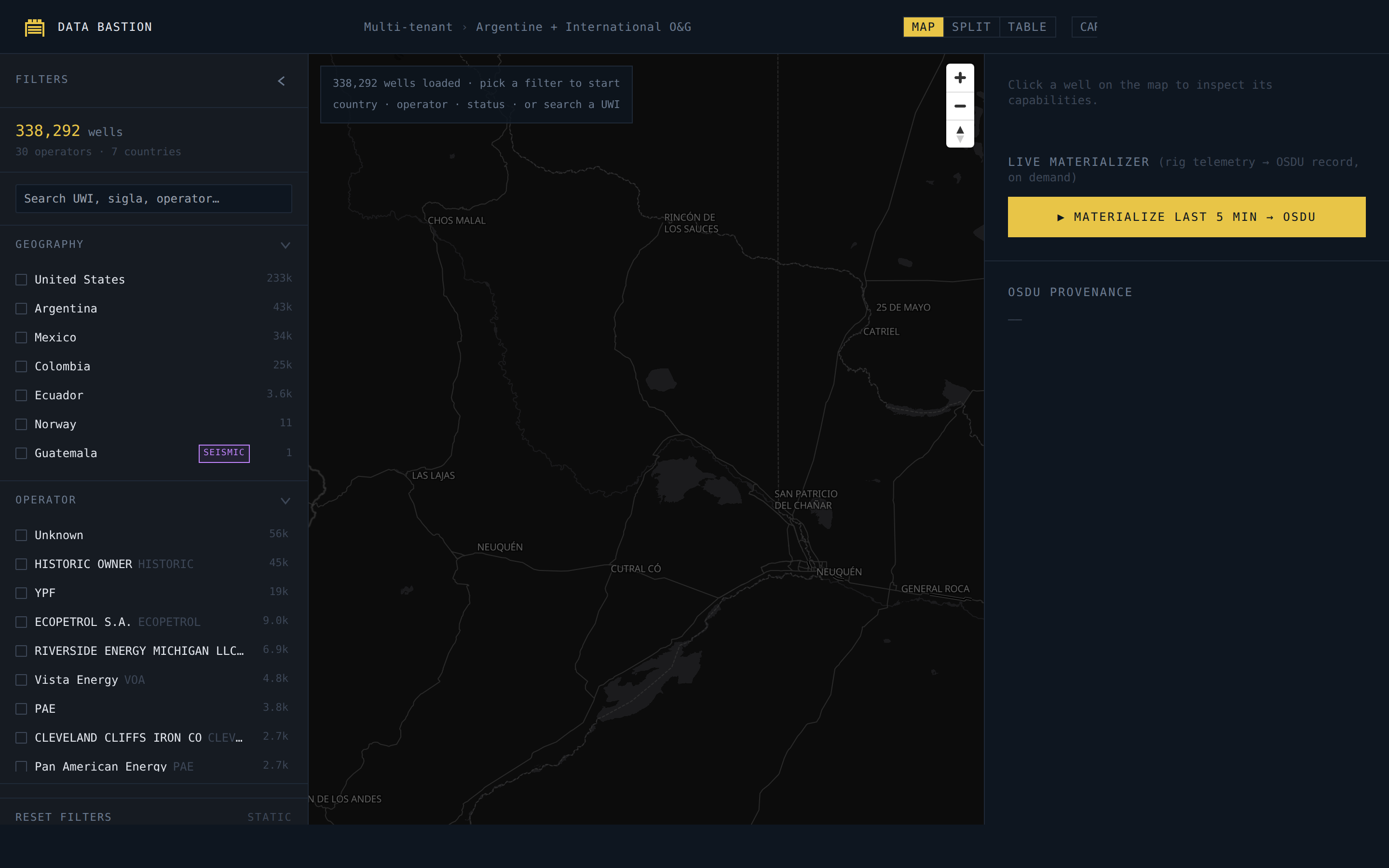
Live and batch structured sources map into the OSDU-aligned registry on the way in, so they arrive described and queryable rather than dumped raw into a staging area no one trusts.
Public upstream registries become governed, tenant-scoped data. The same isolation and lineage rules apply to external sources as to an operator's own feeds.
Scanned permits, regulatory filings and reports are the data everyone else gives up on. Paired with RCI's consensus extraction service, PDF-only sources become structured, auditable records inside the registry.
Once governed, data flows out lineage-tracked and OSDU-aligned, straight into the warehouse, BI and partner systems, without the round-trips and reshaping that lose provenance along the way.
Exchange is the point. The registry is the governed front door, so downstream consumers get clean data with policy and provenance attached rather than a copy they have to re-validate.
Because the model is OSDU-native, the data is not locked to Data Bastion either. Speaking the standard means an operator keeps control of where the data goes next.
Govern every source. Keep your data portable.
See Data Bastion ingest, govern and exchange your upstream data, including the PDF-only sources, with full lineage on every record.